
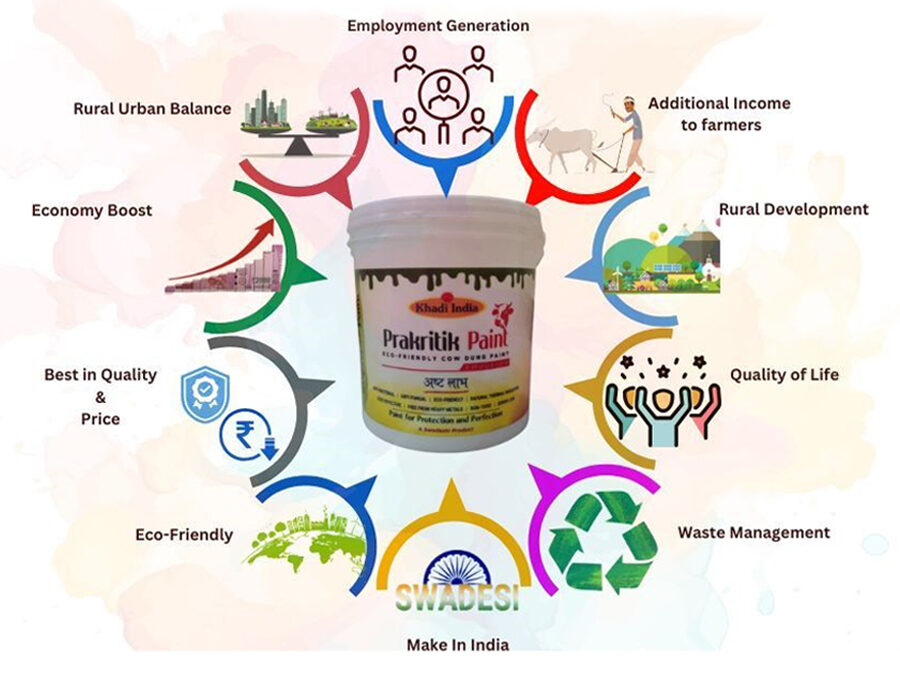
In India, the ancient tradition of using cow dung to coat the walls of rural homes has been reborn as a modern, high-tech solution. Known as Khadi Prakritik Paint, this innovation is a result of blending traditional Indian wisdom with contemporary science to create an eco-friendly alternative to chemical-laden paints.+1
Launched officially in 2021 by the Khadi and Village Industries Commission (KVIC), cow dung paint is now being hailed as a “green revolution” in the Indian construction and decor industry.
What is Cow Dung Paint?
Cow dung paint is a non-toxic, water-based paint where processed cow dung serves as the primary raw material. Unlike traditional “gobar” coatings that are applied raw, modern Prakritik paint undergoes a rigorous manufacturing process to become an odorless, smooth emulsion or distemper.+1
The Science Behind It
The paint is primarily composed of Carboxymethyl Cellulose (CMC) derived from cow dung.
- Cellulose & Lignin: These natural fibers provide excellent adhesion and UV resistance.
- Natural Binders: Ingredients like lime (calcium carbonate), neem extracts, and plant-based gums (e.g., Moringa gum) are used to ensure durability.
- Pigments: It is available in a white base that can be mixed with any colorant to create over 800 shades.
Key Benefits: The “Ashta Laabh” (8 Benefits)
The Indian government and manufacturers often market this paint under the “Ashta Laabh” framework, highlighting eight specific advantages:
- Anti-Bacterial & Anti-Fungal: Cow dung has inherent antimicrobial properties that prevent the growth of mold and harmful bacteria on walls.
- Thermal Insulation: It acts as a natural heat shield, keeping interiors 4–5°C cooler in the summer and warmer in the winter.
- Non-Toxic & Eco-Friendly: It is free from heavy metals like lead, mercury, chromium, and arsenic, which are common in synthetic paints.
- Odorless: Despite its source, the final product is completely odorless and even helps purify indoor air.
- Cost-Effective: It is generally 20–30% cheaper than leading commercial brands.
- Washable & Durable: Modern formulations are BIS-certified (Bureau of Indian Standards) and can be cleaned with water just like plastic emulsions.
- Positive Vastu/Spiritual Energy: Many Indian consumers value it for its traditional “shubh” (auspicious) properties and its ability to reduce radiation.
- Economic Empowerment: It creates a revenue stream for farmers, who can sell raw cow dung for approximately ₹5 per kg.
How It Is Made: The Manufacturing Process
The transition from “waste” to “wall paint” involves several sophisticated steps:
- Refining: Fresh cow dung is mixed with water and processed in a triple-disc refiner to create a fine, smooth pulp.
- Bleaching & Treatment: The pulp is bleached (often using hydrogen peroxide) to turn it white and neutralize any odor. This process extracts the CMC.
- Formulation: The treated base is mixed with calcium carbonate, binders, and natural preservatives like neem to prevent spoilage.
- Grinding: The mixture is ground into a fine paste to ensure a uniform, high-quality finish.
Where Is It Being Used?
Cow dung paint has moved beyond rural huts into diverse modern settings:
- Government Buildings: States like Chhattisgarh have mandated the use of cow dung paint for all government offices and schools to support local self-help groups.
- Eco-Resorts & Heritage Hotels: Architects focusing on sustainable “Green Buildings” use it for its rustic texture and cooling properties.
- Residential Homes: Urban homeowners seeking “low-VOC” (Volatile Organic Compound) options for kids’ rooms or allergy-safe environments.
- Temples & Religious Sites: Used to maintain the sanctity and traditional aesthetic of spiritual spaces.
Regional Hotspots
Production is decentralized across India to minimize transport costs and maximize local employment:
- Jaipur (Rajasthan): Home to the Kumarappa National Handmade Paper Institute, where the technology was developed.
- Chhattisgarh: Leading the country in production through its Gauthan (cattle shed) initiatives.
- Odisha, Uttar Pradesh, and Tamil Nadu: Seeing a rise in private entrepreneurs and KVIC-licensed units.